Common Downspout Problems
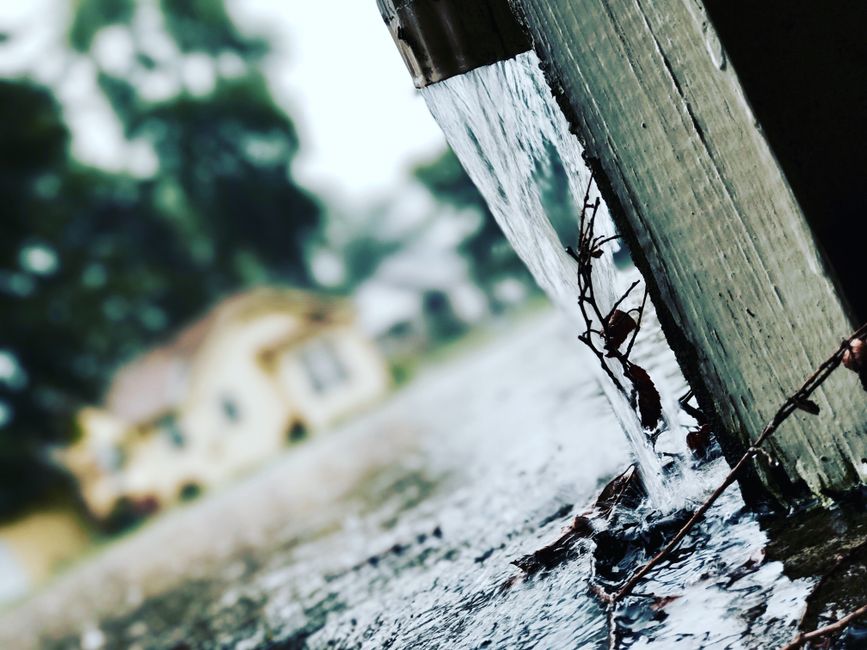
Downspouts don't get much attention until water starts showing up somewhere it shouldn't — pooling at the foundation, running down siding, or backing up into the gutter above. Most of that traces back to one of a handful of recurring downspout problems. Here's what each one looks like and why it happens.
Clogs
A downspout can clog independently of the gutter above it, even when the gutter channel itself is reasonably clear. Leaves, seed pods, and granules washed off roofing shingles travel down into the downspout and can pack together at a bend or narrowing, especially at the elbow joints where the pipe changes direction.
How to spot it: Water overflowing from the gutter above the downspout opening, even though the gutter channel itself doesn't look full, is a common sign that the blockage is inside the downspout rather than in the gutter.
Disconnected or Loose Joints
Downspout sections are joined at seams and elbows, and those connections can loosen or separate over time — from age, from ice expansion in winter, or simply from a joint that was never seated tightly to begin with.
How to spot it: Water visibly leaking or spraying out from a joint partway down the downspout, rather than exiting cleanly at the bottom, points to a disconnected or loose seam. Staining or streaking on the downspout itself below a joint is often visible even when the leak isn't actively running.
Undersized Downspouts
A downspout sized for a smaller roof section or a lighter rainfall pattern than what it's actually handling can be overwhelmed during heavier storms, even when it's completely clear of debris. This shows up most on homes where the downspout count or size was never properly matched to the actual roof area draining into a given gutter run.
How to spot it: Water overflowing the top of the downspout opening itself, or overflowing the gutter right above it, during heavy rain specifically — not during light rain — suggests the downspout isn't moving water fast enough for the volume it's receiving, rather than a clog or debris problem.
Poor Slope and Pooling at the Base
Even a downspout that's clear and properly sized can create a problem if the ground at its base isn't sloped away from the foundation, or if the extension at the bottom doesn't carry water far enough. Water exits the downspout correctly and then has nowhere productive to go, so it pools right back at the point the downspout was supposed to protect.
How to spot it: Standing water, soil erosion, or a visibly soggy patch at the base of a downspout after rain — even when the downspout itself is functioning normally — usually points to a slope or extension problem rather than an issue with the downspout pipe itself.
Why These Problems Compound Each Other
These issues rarely stay isolated. A clog raises pressure on aging joints, making a loose connection more likely to separate. An undersized downspout that's already at its capacity limit has less margin to handle a partial clog before it starts overflowing. And a downspout that discharges correctly but into a poorly sloped yard can look like it's "working" while still contributing to the same foundation and landscaping problems a clog would cause. Addressing one issue without checking the others often means the underlying water problem persists.
Seasonal Patterns Worth Knowing
Downspout problems don't distribute evenly across the year. Clogs tend to build gradually through fall as leaves and seed pods work their way down from the gutter above, often not becoming obvious until the first heavy rain of late autumn overwhelms whatever has collected. Joint separations show up more in winter, when repeated freeze-thaw cycles stress connections that were already slightly loose. Capacity problems — an undersized downspout falling behind during heavy rain — tend to reveal themselves during the heaviest storms of the year, which in Wisconsin often means spring and summer downpours rather than the steadier rain typical of other seasons. Knowing which problem tends to show up when makes it easier to connect a symptom noticed at a particular time of year back to a likely cause.
What to Check
A practical way to work through a downspout is from top to bottom:
- Confirm water is entering the downspout opening cleanly from the gutter above, without overflowing at the connection point.
- Check each joint and elbow along the run for visible leaks, staining, or looseness.
- Watch how the downspout performs during a heavier rain specifically, not just a light one, to catch capacity issues.
- Look at where water exits at the bottom and how far it actually travels before it stops — see downspout extension options for ways to fix a discharge point that isn't carrying water far enough.
The Bottom Line
Clogs, loose joints, undersized pipe, and poor slope at the base cover most of what goes wrong with a downspout, and they tend to make each other worse rather than staying separate problems. Catching which one (or combination) is actually happening is the first step to fixing it properly rather than guessing. Downspout cleaning & repair covers how these issues get diagnosed and addressed on an existing system.